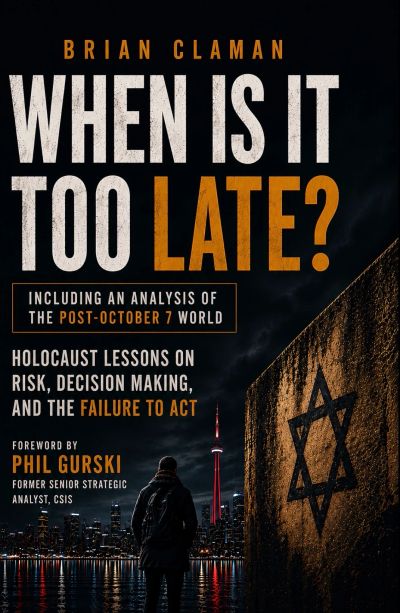
When Is It Too Late?
How do Jews recognize when a familiar world is becoming less safe?
The Hamas attacks of October 7, 2023, and the surge in antisemitism that followed forced many Jews to reconsider assumptions about safety, belonging and the institutions they rely upon for protection.
How should Jewish communities assess danger when daily life continues, yet the environment around them appears to be changing? When does hostile rhetoric become a meaningful security concern? And how long is it reasonable to wait for greater certainty before acting?
These questions are at the heart of When Is It Too Late? Holocaust Lessons on Risk, Decision Making, and the Failure to Act.
The book examines Jewish security in the post–October 7 world through the lens of Holocaust history—not because today is equivalent to Nazi Europe, but because the years preceding the Holocaust offer enduring lessons about recognizing changing risk before the outcome becomes obvious.
At its centre is the documented experience of Maria Katz Claman, a Hungarian Jewish woman who survived Auschwitz, forced labour and displacement before rebuilding her life in Canada. Her story provides the book’s human foundation, but this is not a conventional Holocaust memoir.
It is an examination of security, risk and decision-making under uncertainty.
For Hungary’s Jews, catastrophe did not arrive all at once. Their world deteriorated through antisemitic laws, economic exclusion, forced labour, propaganda and increasing social isolation. Yet ordinary life continued. Families remained in their homes. Businesses operated. Synagogues opened. People worked and planned for the future.
That appearance of normalcy made waiting seem reasonable.
Then Germany occupied Hungary in March 1944. Identification, confiscation, ghettoization and deportation followed with devastating speed. By the time the danger was undeniable, many meaningful choices had disappeared.
The easy question, viewed with hindsight, is why more Jews did not leave.
The harder and more important question is:
What could they reasonably have known—and what could they reasonably have done—before they knew how the story would end?
That question has renewed urgency after October 7.
Jewish communities today face heightened security concerns at synagogues and schools, antisemitism on university campuses, hostility online and in public spaces, and difficult questions about whether institutions will respond effectively when Jews feel threatened.
When Is It Too Late? does not argue that another Holocaust is approaching. Historical analogy has limits, and exaggerating contemporary threats can be as damaging to sound judgment as dismissing them.
Instead, it asks what history can teach us about Jewish security before a crisis becomes unmistakable.
How does hatred become normalized? When does rhetoric become a meaningful indicator of risk? How much confidence should communities place in institutional assurances? And when does waiting for more information cease to be prudent and become a risk itself?
When Is It Too Late? connects the lessons of Holocaust history with the security challenges confronting Jews after October 7. It offers a framework for recognizing change, challenging assumptions and assessing risk when certainty is impossible.
The book does not tell Jews they should be afraid.
It argues that they should be aware.
Because history rarely announces the moment when a familiar world has become dangerous.
The challenge is recognizing that change while meaningful choices still remain.
This is substantially tighter while preserving the core argument and, importantly, keeping the explicit safeguard against equating today’s circumstances with the Holocaust.
Taken. Numbered. Survived.: A Holocaust Survivor's Journey
She was 17 years old when everything ended.
Within minutes, her fate was decided.
Taken. Numbered. Survived. is the true story of Mary Katz Claman, a Hungarian Jewish teenager deported to Auschwitz-Birkenau in 1944 and forced into a system designed for mass destruction.
Born into a close-knit family in northeastern Hungary, her early life was defined by tradition, community, and stability. That life disappeared in weeks. After the German occupation, she and her family were forced into the Kisvárda ghetto and then deported in a sealed cattle car to Auschwitz.
When the train doors opened, everything changed.
Men were separated from women. Families were torn apart. A single gesture from an SS officer determined who would live and who would die. She was sent to forced labor. Many of her family members were sent in the other direction and never returned.
Inside Auschwitz, her name was taken from her.
She became a number: A12064.
This book follows her journey through Auschwitz, forced labor in Germany, and the final months of the war. It documents the reality of daily survival inside the camps: starvation, disease, cold, and constant uncertainty, where survival often depended on chance as much as strength.
But this is not only a story of survival.
After liberation, she endured displacement, uncertainty, and the long process of rebuilding. She eventually immigrated to Canada, where she built a life, raised a family, and carried the memory of what happened for decades.
What sets this book apart is its foundation.
This is not a fictionalized account. It is based on recorded survivor testimony and supported by archival documentation from institutions including the Arolsen Archives, Yad Vashem, and the United States Holocaust Memorial Museum. Every event is grounded in verifiable evidence.
This book does more than tell a story.
It shows how the Holocaust functioned as a system.
It traces one individual life through a structure that was organized, documented, and deliberate, from deportation to forced labor to survival.
For readers of Holocaust history, World War II, and survivor testimony, this is both a personal account and a documented record.
It is a story of loss.
A story of survival.
And a record that cannot be erased.
