Discover the Best Books Here
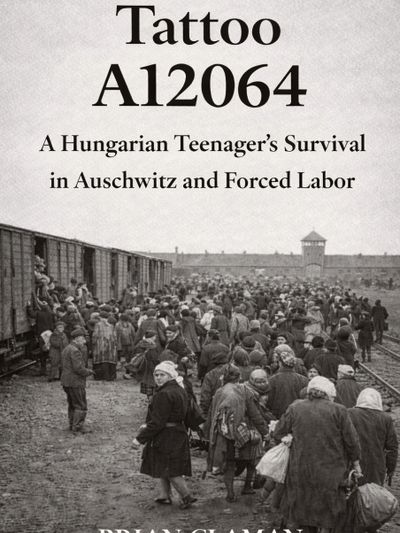
Tattoo A12064; A Hungarian Teenager's Survival in Auschwitz and Forced Labour
At seventeen, Maria Katz was deported from Kisvárda, Hungary to Auschwitz-Birkenau. Within hours, she was separated from her family and tattooed with the number A12064. Most of those who arrived with her were murdered on arrival. She survived.
Tattoo A12064 is a narrative account of Maria Katz Claman, a Hungarian Jewish teenager who was deported to Auschwitz, forced into labour, and ultimately survived to rebuild her life in Canada.
The book traces her experience chronologically:
- Childhood in Kisvárda and Pátroha
- The escalation of antisemitic laws in Hungary
- Ghettoization and deportation in 1944
- Arrival and selection at Auschwitz-Birkenau
- Imprisonment under conditions of starvation, cold, and constant threat of death
- Tattooing and loss of identity within the camp system
- Daily survival inside Auschwitz-Birkenau
- Transfer to forced labour at HASAG-Altenburg
- Liberation and displacement
- The rebuilding of a life after the Holocaust
- The enduring legacy of survival
What distinguishes this book is its approach.
It is not written as a traditional first person memoir. Instead, it reconstructs lived experience through a clear, chronological narrative grounded in recorded testimony and supported by historical context.
The emphasis is on immediacy, clarity, and readability.
The account follows events as they were experienced, allowing the reader to understand the progression of the Holocaust from the perspective of a seventeen year old girl moving through it in real time.
All events are grounded in recorded testimony, including the USC Shoah Foundation interview, and supported by verified historical sources.
The purpose extends beyond storytelling.
It is to present lived experience in a form that is accessible, direct, and faithful to what occurred, without fictionalization or embellishment.
How It Relates to From Kisvárda to Canada
These two books are intentionally designed to work together.
They tell the same story, but in different forms:
Tattoo A12064
- Narrative-driven
- Focused on lived experience
- Structured for clarity and accessibility
- Follows events as they were experienced
From Kisvárda to Canada
- Evidence-driven
- Structured as historical nonfiction
- Built on archival documentation
- Situates one life within the full machinery of the Holocaust
As established in the work itself:
One presents the experience
The other establishes the record
Combined Purpose
Together, the books create a complete and reinforced account:
Testimony provides memory
Documentation provides verification
When aligned, they produce a historical record that is stronger, more precise, and more resistant to distortion or denial.
Tattoo A12064 traces her path through the Holocaust from prewar life, to ghettoization and deportation, to survival inside Auschwitz, forced labour at HASAG-Altenburg, and ultimately liberation and rebuilding her life in Canada. The book presents her experience in a clear, direct narrative, grounded in her recorded testimony and supported by verified historical context.
This is not a fictionalized account. Every event is based on documented testimony and archival evidence.
Tattoo A12064 is a companion to From Kisvárda to Canada: My Mother’s Holocaust Journey.
Both books tell the same story, but in different ways:
- Tattoo A12064 presents the story as a focused, readable narrative of lived experience
- From Kisvárda to Canada presents the same history within a fully documented framework, supported by archival records, transport lists, and historical sources
Together, they serve a shared purpose:
- One tells the story
- The other documents and verifies it
At a time of rising antisemitism and Holocaust denial, this dual approach strengthens the historical record by aligning survivor testimony with independent evidence.